
1 Peter 2:17 “Show proper respect to everyone, love the family of believers, fear God, honor the emperor.”
My good friend A.M. Hickman released his open letter last month to Orthodox Christians on why even after being an Orthodox catechumen, he returned to Roman Catholicism. As someone who considers myself to be thoroughly Western, with a great devotion to my heritage, why did I choose Orthodoxy? In this response, which he graciously encouraged, I aim to show you why it is not only reasonable, but imperative, that one who lives in the West choose Orthodoxy over Rome.
To give some detail on my background, I grew up nominally Christian and occasionally attended a non-denominational megachurch. In 2020, I found Orthodoxy online, unrelated to the Covid convert boom, forever changing the direction of my life in countless ways. When I first set out on my theological journey, I had not a single idea where I would end up. However, it quickly came down between Roman Catholicism and Orthodoxy. Naturally feeling more comfortable with Catholicism due to family heritage and its cultural presence, I was compelled towards Catholicism. However, some of the factors which I will list below quickly reared their head, while at the same time Orthodoxy simply clicked on every single theological issue. Orthodoxy became clear not simply because of the faults of Rome, but because I truly believe in Orthodox Christianity for what it is and what it teaches. In 2024 on the feast of Sts. Peter and Paul, I was baptized into the Orthodox Church under the Greek Orthodox Archdiocese of America under the name of Nicholas, after St. Tsar Nicholas II.
As a self-proclaimed traditionalist who runs a publication devoted to the humanities from the viewpoint of Western intellectual heritage, some may say, such as Hickman, that I should “come home to Rome.” However my reply to this would be simply, “I am already home, for my soul is at peace.” I truly believe that there are countless Roman Catholics who are devout people, who love God with all their heart, soul, and mind, but I would encourage them…do not just stay in the outer rooms where you may see the glistening fire. Come, warm yourself at the hearth, where we may have unity once again, East and West, and truly, return home to tradition.
Unity and Eastern Catholicism
While I agree with Hickman that often such theological disputes devolve into nothing more than pettiness, I believe it to be critical that such discussions occur for not only the sake of traditionalists, but for the sake of eternal life! Though both of us cannot be right, it is essential that people choose the path that will allow them to have full confidence that they are following after the Church that the Lord Jesus Christ established.
1 Corinthians 1:10 “I urge you, brothers, in the name of our Lord Jesus Christ, that all of you agree in what you say, and that there be no divisions among you, but that you be united in the same mind and in the same purpose.”
To address the first point that I understand Hickman to make, is that of unity. While unity is of course vital, as the verse above states, a man should not keep a limb if it is to take his very life from him. This is how we, the Orthodox, view the tragedy that is the schism between East and West. While he speaks about how we must be of one mind and faith for the sake of organization and fellowship, it is to be understood from our side that while that sounds wonderful, we would never accept it under such circumstances as are dictated by Rome. We will never “submit to Rome” in a post Council of Florence world, not to mention Trent, Vatican I, or Vatican II, which was effectively the nail in the coffin for reunion efforts ever happening. The oft-repeated phrase one hears in these discussions from the Orthodox side, which I strongly affirm, is that Rome will accept heresy if it will prevent schism, but the Orthodox will accept schism if it will prevent heresy from infecting the Church. While not going into a completely apologetical argument, one need look no further than the Eastern Catholic churches, which those within the Latin church have so often marginalized historically by their own admittance, to blatantly see this. The Eastern Catholics go on about how they are “just like the Orthodox, but with the pope.” They say this in such a positive sense! Rome allows them to not only omit the Filioque from their recitation of the creed, but to venerate certain Orthodox saints, if they only kiss the ring for the sake of “unity.” To quote Hickman, “When I crave the Divine Liturgy of Saint John Chrysostom — complete with the omission of the Filioque, if I like — I now go to Eastern Catholic Churches, where one would not know they were not in an Orthodox Church but for the portrait of Pope Francis in the narthex.” As someone who is Orthodox, I would far rather have a true union of common faith, rather than an organizational arrangement to appear under one umbrella. Below I quote Canon 112 of Roman Catholic Canon Law on how a Roman Catholic can scarcely move from the Latin Church to Eastern or vice versa.
“1° one who has obtained permission from the Apostolic See;
2° a spouse who, on entering marriage or during its course, has declared that he or she is transferring to the Church ‘sui iuris’ of the other spouse; on the dissolution of the marriage, however, that person may freely return to the Latin Church;
§2. The practice, however long standing, of receiving the sacraments according to the rite of another Church ‘sui iuris’, does not bring with it membership of that Church.”
As can be seen from this quote, one cannot simply transfer to their local Eastern Catholic parish from their standard Latin parish. The idea that Roman Catholics purport of their being a universal, unified church, is completely false. Further, there is the issue of Eastern Catholics venerating saints which undermine the Roman Catholic faith.
“Some of the Byzantine rite usages, for example, venerate St. Gregory Palamas, whose office is in an appendix in the office book published for Greek Catholics in Italy. So the simple answer is yes, the Catholic Church would generally accept the veneration of Orthodox saints in the case where there is a reconciliation of the communities. This seems to be the case with St. Seraphim of Sarov for Russian Catholics under St. Pius X.” (Source)
For reference, St. Seraphim of Sarov reposed in 1833. Other Orthodox saints they venerate (post-schism, of course) are St. Sergius of Radonezh, St. Stephen of Perm, and Sts. Anthony and Theodosius, to name a few. The big thing to notice here is St. Gregory Palamas, who not only reposed between 1357-1359, but had some choice words for Roman Catholicism.
“The Latins, however, assert that the Spirit proceeds from both the Father and the Son. This is a serious error, for the Fathers have never taught this, and to say so is to distort the mystery of the Holy Trinity.”
– St. Gregory Palamas (Triads in Defense of the Holy Hesychasts, 1.3.19)
“In 1971, the Holy Synod approved commemorating Gregory Palamas on the Second Sunday of Great Lent. The reason was that Gregory Palamas’ theology is the basis for many prayers. Also, that Holy Synod wrote a Kontakion and a Troparion for Gregory Palamas.” Since 1971 the Melkite Greek Catholic Church has officially recognized him as a saint. How can there then be unity of faith, when some Catholics are venerating saints which undermine the very integrity of the faith as a whole which they adhere to? Therefore, how can one venerate someone as a Roman Catholic who blatantly stated their repudiation in such clear terms of one of the primary differentiating factors? It is crystal clear, that one cannot. I have heard such arguments against this as that St. Gregory Palamas, due to the “infallible canonization of the Catholic Church” must have repudiated these statements before his repose, yet what source is there for this? There is not one.

Theology or Western Identity
Another issue which I will raise against what I have heard from Hickman which I find to be a larger issue with people who are traditional Catholics (not tradcaths necessarily) is that of Western identity. I find that many Roman Catholics will have such a focus on their Western identity, that is becomes placed on a pedestal in comparison to theological concerns. While I wholeheartedly promote a focus on Western culture and heritage, it comes second to my belief in theology. If what I truly believed to be the right theology came from Japan for example, I would have to humbly lay down my pride and follow after that system of belief. I follow the Orthodox Church because I believe in its historical continuity and theology, not because of any other reason. It is not an issue of heritage to me, even if the Divine Liturgy was served in Greek or Russian, for I would have complete confidence that it was the truth. Do I believe that in places where English is the native language that it should be served in that language? Of course! This is something I tirelessly will advocate for, and acknowledge the faults of for some Orthodox jurisdictions, who I wish will continue to adapt as we grow in the West. Even if I had no community after Liturgy, even if it was far away, that would still be my parish, because I believe with all of my being that it is definitively the truth. Now, I have been fortunate in my personal experience, and anecdotally from others, that it is rarely the case to find a parish in the Western world who only does services in the non-native language. As far as community goes, thanks to the boom of converts, parishes across the Western world are witnessing a higher ratio of converts to cradle by the day. My home parish I would estimate to be 60% cradle and 40% convert. While this of course varies based on where one goes, it is sometimes more converts or less.

This brings up my refutation that Orthodoxy is simply an ethnically based religion. When Pope John Paul II was decided upon in 1978, he became the first non-Italian pope in 455 years. For a church that claims that universality is one of its main appeals, this appears quite centralized to me. When one looks at Roman Catholic Churches in the United States, it is seen how there were Italian Catholics, Irish Catholics, Slovakian Catholics, and so forth. These differences in the early 20th century were so striking that we get quotations such as this, “[Cardinal] O’Connell tried to moderate the Italians’ feast days in honor of village saints. To non-Italians the festivals hardly resembled religious ceremonies.” We see further, “O’Connell discouraged these festivals and usually permitted them only upon assurance by Italian pastors that “due religious decorum” would be maintained.”
Not only were these superficial issues though, but caused real division. “Different modes of religious expression prompted further alienation. Italian church services were far more demonstrative than those of the more decorous Irish. No Irishman, for instance, would enter a church wearing a hat and puffing on a cigar; nor would he profess his human frailties prostrating himself before a crucifix or Station of the Cross. The Irish priest, whose devotions centered around the all-male Holy Trinity, encountered the matriarchal Italian family, which focused on the Madonna and Child.” There were clearly different ways of going about things, and not just this modern idea of a universal church were one could freely walk into any mass and hear the same Post-Vatican II hymns. While of course there are differences in Orthodoxy that develop from one jurisdiction from the next, they are minor in comparison to the Gallicans and Ultramontanists of Vatican I which had radically different conceptions of the Roman Catholic Church.
Now my response to the part about Western identity from the Orthodox standpoint is quite simply two-fold. Firstly, and ideally in my opinion, is the further promotion and establishment of the Western Rite. As someone who has experienced an Orthodox Western Rite mass and who is active in the movement in both the U.S. and U.K. I can say firsthand that it opens many peoples minds. When one mentions “Eastern Orthodoxy” to someone who may be Roman Catholic or Anglican, it is an immediate perceived barrier due to misconceptions. However, when I introduce them to the Western Rite, they are almost always immediately interested. To address a misconception, the Western Rite is not just an ancient recreation, but commonly uses the mass of St. Gregory the Great, or St. Tikhon’s mass, which is largely similar but with English patrimony. Further, it is not just a continuation from 1054, but rather takes post-schism elements which are not in conflict with Orthodox doctrine or practice, such as the rosary which Hickman specifically mentions. This speaks to the fact that yes, Western culture is extremely important, but it also leads me into my second point. Alternatively at the end of the day, it is better to be in the Church, than to be outside of it, even if it means not having your particular sense of Western identity fulfilled. Trust me when I say that I know just how important it is to have that sense of Western identity, hence why I work so fervently for the Western Rite! However someone in Orthodoxy who is in a more Eastern focused parish that has not yet seen multiple generations from its period of immigration, may feel that they are at odds with their native culture. I am completely fine with affirming that yes they are, and that is ok. It is completely ok to be, in a sense, an exile from your own land. The White Russians were exiled from their homeland, but never stopped fighting for their heritage and culture from afar. This is similarly the case with someone who becomes Orthodox in the West, except that they remain geographically stable. I believe this is a great benefit, in that those who are Orthodox in the West can work within their culture and society to create change around them, not from afar. Therefore the two approaches are to further the Western Rite, (which is by far the ideal option, but I will write more on that soon) or to simply live as an “exile” in a sense, while pursuing a life in the Church, allowing for a clear conscience.
“Never, never, never let anyone tell you that, in order to be Orthodox, you must be Eastern. The West was fully Orthodox for a thousand years, and her venerable liturgy is far older than any of her heresies.”
-St. John of Shanghai and San Francisco

The Numbers Game
Hickman in his letter mentions that he wishes to be in communion with the most Christians in the world, and that Orthodoxy only makes up a percentage of the Roman Catholic membership in regards to numbers. However as he admits, this is not a primary facet of his argument, though he alludes to the fact that he believes that Christ would not allow the smaller group to necessarily be the correct one. As an Orthodox person, I bite the bullet on this one, and would say that indeed there are far, far fewer people who will enter paradise than we often think. What I mean by this is that as someone who believes that the Orthodox Church is the path to salvation, this already greatly narrows the numbers in which we are dealing. Further, of the people who are actually within the Orthodox Church, one must ask how many of the people there on Sunday will actually reach paradise. After all, one must hold to truth, no matter how bitter it is.
While not going on about this point, I will highlight some valuable statistics that will evidence the Traditional Latin Mass (of which Hickman is a fan of) attendance statistics. These statistics aim to show that those who follow after traditional Catholicism (the most authentic expression as many will argue today, even if they accept Vatican II) are the minority, and not of any substantial influence. There are roughly 51 million Catholics in the U.S. with about 65% to be considered practicing (about 33 million). There are about 16,000 parishes in the U.S. (16,702 in 2021), and 4% offered TLM (668 parishes). On average, each parish offers one TLM per week. Average mass attendance in each mass was just shy of 200. So, in any given week, 133,600 Americans attended a TLM. Pew and Gallup reported that between 30% and 40% of Catholics attend mass in any given week. Even just considering practicing Catholics (the 33 million), that’s between 9.9 and 12.4 million Catholics attending a non TLM. So, 0.4% of practicing Catholics attend TLM on any given week. So traditional Catholics (not saying Hickman) are in no place to claim that Orthodoxy is a small group, and therefore gives it irrelevance. To further illustrate this point, and to see some of the cultural issues with Roman Catholicism, you can see a recent post by Hickman and the comments beneath it.
Theological Issues
Now to expand on some of the theological points as to why I am not Roman Catholic, I will just briefly list some bullet points below which I hope will illustrate my reasoning, or at the very least raise important questions in your mind.
Ecclesiological Concession
Papal Ball Unam Sanctum is one of the largest obstacles, in my opinion, that Catholics have to overcome (unsuccessfully) today. It restricts salvation to only those under the authority of the Rome.
Bull of Pope Boniface VIII promulgated November 18, 1302:
“Urged by faith, we are obliged to believe and to maintain that the Church is one, holy, catholic, and also apostolic. We believe in her firmly and we confess with simplicity that outside of her there is neither salvation nor the remission of sins…”
This becomes an issue firstly, when Eastern Catholicism comes into the discussion, and secondly, with the 21 Coptic martyrs. Considering what I spoke about earlier regarding St. Gregory Palamas being venerated by Roman Catholics, who was blatantly against the innovations of Rome, and who clearly died outside of submission to the Roman church. This argumentation is simply repeated for the other Orthodox saints who are venerated by Catholics, of which there are several. However, Catholics will try to argue generally that such cases are those of what they term “invincible ingorance.” This is not the case, for St. Gregory Palamas even by their own definition…which is, “Pope Pius IX gave a speech in which he acknowledged that “it is necessary to hold for certain that they who labor in ignorance of the true religion, if this ignorance is invincible, are not stained by any guilt in this matter in the eyes of God.” St. Gregory Palamas clearly knew, in complete soundness of mind, what he was was stating, with no proof to the contrary. It is by this logic that Catholics could say that St. Mark of Ephesus, if canonized by Rome, was clearly a supporter of their theology! To show how far this is from the truth, let me quote St. Mark of Ephesus at the Council of Florence: “The Latins are not only schismatics but heretics… we did not separate from them for any other reason other than the fact that they are heretics. This is precisely why we must not unite with them unless they dismiss the addition from the Creed filioque and confess the Creed as we do.” It can be clearly seen how absurd this logic is when furthered.
A further contradiction is drawn from one of the main documents of Vatican II, Lumen Gentium. In paragraph 16 it says, in contradiction of the earlier papal bull: “Those also can attain to salvation who through no fault of their own do not know the gospel of Christ or his Church, yet sincerely seek God and moved by grace strive by their deeds to do His will as it is known to them through the dictates of conscience. Nor does divine Providence deny the helps necessary for salvation to those who, without blame on their part, have not yet arrived at an explicit knowledge of God and with His grace strive to live a good life…” A clear innovation.
Now, the 21 Coptic martyrs. 20 of them were Coptic Christians, while one was from Ghana, but professed the Christian faith in his last moments. Pope Francis said, “I am glad to announce today that, with the consent of Your Holiness, these 21 martyrs will be inserted into the Roman Martyrology as a sign of the spiritual communion uniting our two Churches…”
Conciliarism
From the Chieti Document from the Vatican Dicastery for Promoting Christian Unity:
“There is abundant evidence that bishops in the early Church were conscious of having a shared responsibility for the Church as a whole. As St. Cyprian said: ‘There is but one episcopate but it is spread amongst the harmonious host of all the numerous bishops’. This bond of unity was expressed in the requirement that at least three bishops should take part in the ordination (cheirotonia) of a new one; it was also evident in the multiple gatherings of bishops in councils or synods to discuss in common issues of doctrine (dogma, didaskalia) and practice, and in their frequent exchanges of letters and mutual visits.”
This excerpt evidences the fact that the early church was of a conciliar nature, in sharp contrast to the way that the Roman Catholic Church has operated for centuries.
The Appointment of Bishops
Directly below, I cite the fourth canon of the First Ecumenical Council to evidence the contrast and departure that follows below.
“It is by all means proper that a bishop should be appointed by all the bishops in the province; but should this be difficult, either on account of urgent necessity or because of distance, three at least should meet together, and the suffrages of the absent [bishops] also being given and communicated in writing, then the ordination should take place. But in every province the ratification of what is done should be left to the Metropolitan.“ -First Ecumenical Council, Fourth Canon
“The ultimate decision in appointing bishops rests with the pope, and he is free to select anyone he chooses.“ – United States Conference of Catholic Bishops
“It was at the beginning of the 19th century, with the concordat between the French emperor Napoleon and Pope Pius VII, that the pope alone was vested with the power to appoint and remove bishops anywhere in the Roman Catholic church” “That system has remained in place ever since. It was given formal legal status in 1917 with the promulgation of the new Code of Canon Law (canon 329, n. 2).” (Fr. McBrien, Crowley-O’Brien Professor of Theology at the University of Notre Dame)

Vatican I
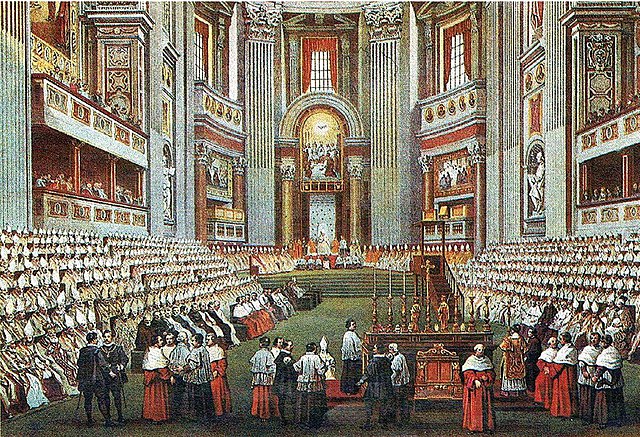
From the Orthodox standpoint, in my opinion, the death nail for reunion originally was the Council of Florence, However, when one moves further, it becomes Trent and then Vatican I, which was simply actualized on in Vatican II. Roman Catholics of the Vatican I era, both laity and clergy, believed that an innovation had occurred in the dogma of papal infallibility.
“In 1825, a British Parliamentary Royal Commission was established in view of the forthcoming Catholic Emancipation Act of 1829. Some of the questions put to Roman Catholic Bishops are as follows:
Question to Bishop Doyle
Q: Is the authority of the Pope in spiritual matters absolute or limited?
A: It is limited.
Questions to Bishop Murray
Q: Is that (Papal) authority under the control of General Councils?
A: That authority is limited by the councils and canons of the Church; he is the executive power of the Church, appointed to preside over it and enforce its canons or laws. Those canons vest in individuals, for instance in Bishops, certain rights, which of course is the duty of the Pope to protect and not violate; his authority is thus limited by those canons.”
Question to Bishop Murray
Q: Is the decree of the Pope valid without the consent of the Council?
A: A decree of the Pope in matters of doctrine is not considered binding on Catholics, if it have not the consent of the whole Church, either dispersed or assembled by its Bishops in Council.
“In 1826, the declaration of the Archbishops and Bishops of the Roman Catholic Church in Ireland, was endorsed by the signatures of 30 bishops, declaring that The Catholics of Ireland declare on oath their belief that it is not an article of the Catholic faith, neither are they required to believe that the pope is infallible. Archbishop Kenrick of St. Louis pointed out in his undelivered speech, which he had published in Naples, that for two hundred years a book had been in circulation entitled Roman Catholic Principles in Reference to God and the King. It enjoyed such a wide circulation that from 1748 to 1813 it underwent 35 editions and the Very Reverend Vicar Apostolic Coppinger in England had 12 printings of it. On the question of Papal Infallibility it states:
“It is no matter of faith to believe that the Pope is in himself infallible, separated from the Church, even in expounding the faith: by consequence of Papal definitions or decrees, in whatever form pronounced, taken exclusively from a General Council, or universal acceptance of the Church, oblige none, under pain of heresy, to an interior assent.”
“The [Emancipation] Act of 1791 for England was followed by that of 1793 for Ireland. The Oath inserted in this Act is founded upon the Declaration of 1757, and embodies a large portion of it, including the words:
“It is not an article of the Catholic Faith, neither am I thereby required to believe or profess, that the Pope is infallible.”
“On the 26th of February, 1810, those Bishops declared as follows: “That said Oath, and the promises, declarations, abjurations, and protestations therein contained are, notoriously, to the Roman Catholic Church at large, become a part of the Roman Catholic religion, as taught by us the Bishops, and received and maintained by the Roman Catholic Churches in Ireland ; and as such are approved and sanctioned by the other Roman Catholic Churches.”
It does not get more unequivocal than this.
“In 1822, he [Bishop Baines] wrote as follows: “Bellarmine, and some other Divines, chiefly Italians, have believed the Pope infallible, when proposing ex cathedra an article of faith. But in England or Ireland I do not believe that any Catholic maintains the infallibility of the Pope.”
Papal Supremacy
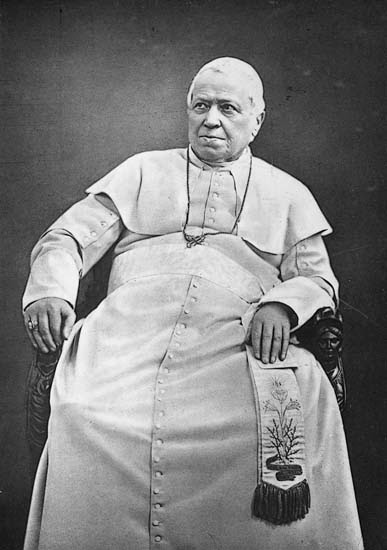
“Shall they prove that the Roman bishop’s judgment is greater than God’s?…Let us not give occasion to the envious to think that the episcopate, which is one as the Catholic Church is one, should seem to be subject to one man.” (Gerbert of Aurillac, who became Pope Sylvester II–who reposed in 1003, just 51 years before the Great Schism.)
Pope Benedict XVI in 2007 said:
“How well known and highly esteemed Chromatius was in the Church of his time we can deduce from an episode in the life of St John Chrysostom. When the Bishop of Constantinople was exiled from his See, he wrote three letters to those he considered the most important Bishops of the West seeking to obtain their support with the Emperors: he wrote one letter to the Bishop of Rome, the second to the Bishop of Milan and the third to the Bishop of Aquileia, precisely, Chromatius”
Why would he have to appeal to other Sees, “to those he considered the most important Bishops in the West”, if Rome was supreme? Rome clearly did not have the most important say in such a matter.
Saints
You can get an interior view of a faith based on its saints. In this case, it just takes a few moments to look at some specific post-schism Catholic saints that I have come across in my research who display what I would argue is a distorted “spirituality.”
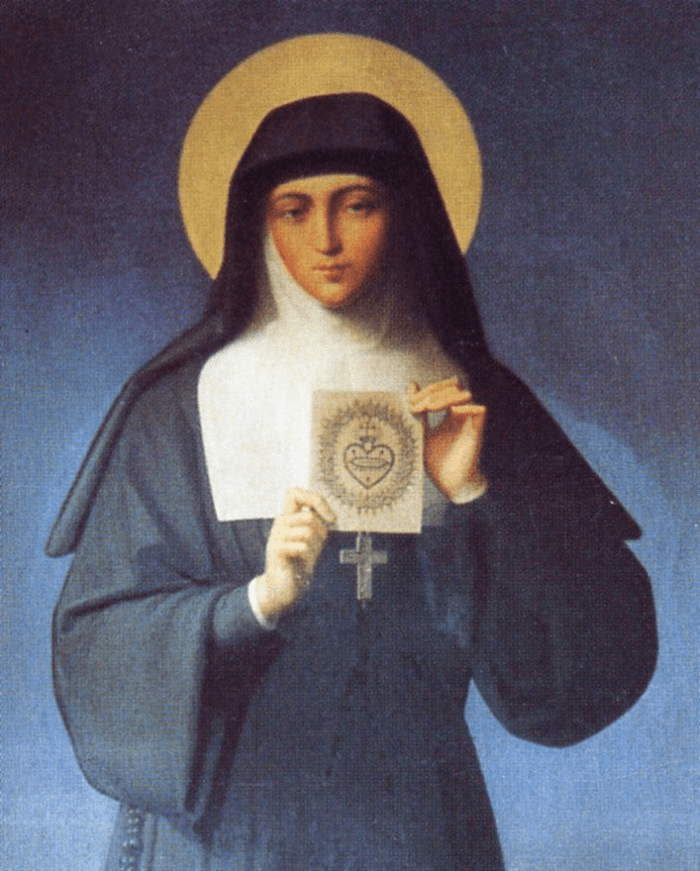
Grotesque Behavior and the Sacred Heart: St. Margaret Mary Alacoque
She was the Roman Catholic saint who popularized the devotion to the sacred heart.
“The Mother having assented, Sister Margaret Mary went to her cell, bared her breast, and, imitating her illustrious and saintly foundress, cut with a knife the name of Jesus above her heart. From the blood that flowed from the wound she signed the act in these words: ” Sister Margaret Mary, Disciple of the Divine Heart of the Adorable Jesus.” “Resting on the permission that she had received, she tried once or twice to renew them by opening the lines with a knife; but not succeeding according to her liking, she determined to apply fire.” “Once, in particular, when nursing a Sister dying with cancer of the stomach, and who could not retain anything upon it, she wished to clear away her vomit. She did it with her lips and tongue, saying to Jesus Christ: “If I had a thousand bodies, a thousand loves, and a thousand lives, I should wish to sacrifice them all, in order to be Thy slave.”
Sensuality and St. Teresa of Avila
“I saw in his hand a long spear of gold, and at the iron’s point there seemed to be a little fire. He appeared to me to be thrusting it at times into my heart, and to pierce my very entrails; when he drew it out, he seemed to draw them out also, and to leave me all on fire with a great love of God. The pain was so great, that it made me moan; and yet so surpassing was the sweetness of this excessive pain, that I could not wish to be rid of it. The soul is satisfied now with nothing less than God. The pain is not bodily, but spiritual; though the body has its share in it, even a large one. It is a caressing of love so sweet which now takes place between the soul and God, that I pray God of His goodness to make him experience it who may think that I am lying.”

Stigmata and Intense Mortification Roman Catholic Servant of God Therese Neumann
This is the most visually shocking example of the theological innovation (from the Orthodox standpoint) of the stigmata/new depths of physical anguish and mortification. She was said to bleed from her eyes and the stigmata on her hands.
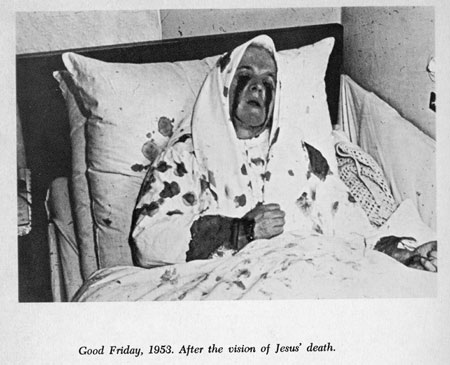
(Johannes Steiner, Therese Neumann. A Portrait Based on Authentic Accounts, Journals, and Documents, Staten Island 1967)
Victim Souls and St. Gemma Galgani
Victim soul theology is a major issue upon which I have stumbled, which many people are not aware of, even in Orthodox circles. Below is quotation from one of the most famous “victim souls” which I believe illustrates my point. The below quotation was when she was in a state of ecstasy and thought she was talking to Christ.
“My child, I have need of victims; strong victims, in order to appease the just anger of my Divine Father. I need souls who, by their sufferings, trials and sacrifices, make amends for sinners and for their ingratitude. Oh, if I could make all understand how angry My Father is by the impious world!”

Contrasting Modern Orthodox Saints/Holy People
Below I include some quotations and icons relating to Orthodox saints and venerable people who are likely to be canonized in the future, who have not officially been canonized yet but provide a particular account of our spirituality. I want to provide a brief contrast to show why, when I admire and venerate such saints, I am so stunned by the people I have listed above. The saints I have listed below are very contemporary, as they have all reposed in the 20th or 21st century.
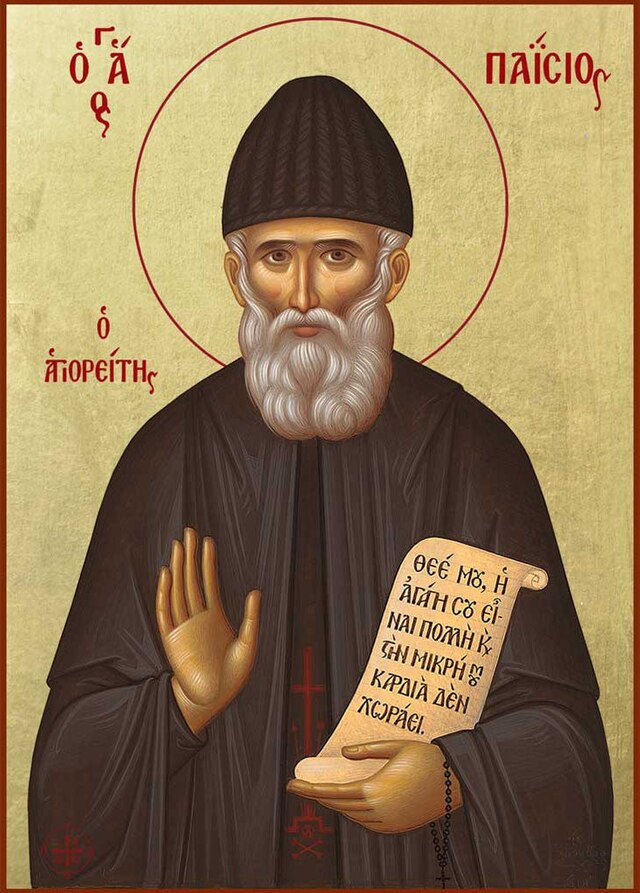
St. Paisios
“He was beloved by the Bedouins, giving them food and money which he earned by selling to the pilgrims wooden crosses that he made himself. The Arab children in the area often visited Father Paisios. He wished that he had something to give them, but when he brought his handiwork to the Monastery he asked for some cookies and was told that he had to bring more handiwork to obtain cookies. Father Paisios shortened his Prayer Rule and spent more time for his handiwork so that he might have cookies for the children. By this act of love, he discerned that he received even more grace from God.” (Source)
He reposed in 1994. I am blessed to know people who knew him.
Dobri Dobrev
“Dobri Dimitrov Dobrev was born on July 20, 1914 in the village of Bailovo. His father died in World War I and his mother raised the children. He married in 1940, when Bulgaria was participating in the Second World. A shell fell near him during one of the bombings in Sofia, depriving him of nearly all his hearing. He had four children with his wife, two of whom he outlived.
Over the years, the elder became more and more detached from the material aspects of life, devoting himself entirely to the spiritual life. Around the year 2000, he donated all of his belongings to the Orthodox Church and began living in a small and modest addition to the Sts. Cyril and Methodius Church in his native village. It is also about that time that he began to collect money towards the restoration of churches and monasteries throughout Bulgaria.
An icon of charity, he came under the spotlight when it was revealed that for years he had walked more than 12.5 miles to reach Sofia from his home in the village of Bailovo to beg for money and then donate it for charity. After spending years at the entrance of the Alexander Nevsky Cathedral, with a plastic cup in his hand, he collected about BGN 40,000 ($24,700 today) for the cathedral in Sofia, BGN 10,000 ($12,350 today) for the Sts. Cyril and Methodius Church in Bailovo, and BGN 25,000 ($31,000 today) for the restoration of the Eleshnishki Monastery of the Mother of God located to the east of Sofia, and the local church of the Gorno Kamartsi village.” (Source)
He reposed in 2018 at the age of 103.

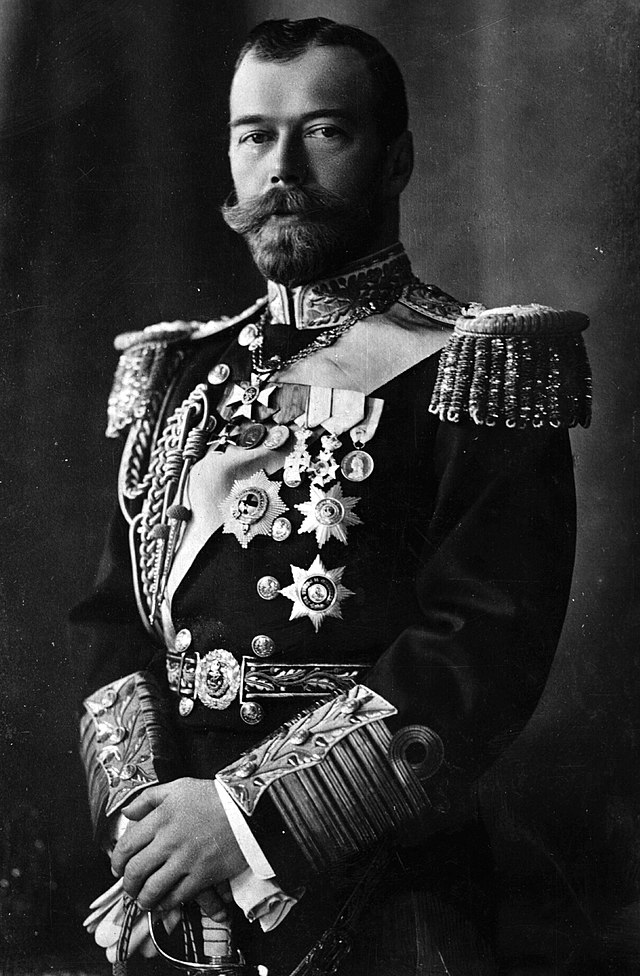
St. Tsar Nicholas II (My Patron Saint, St. Tsar Nicholas, Pray For Us!)
“In 1905, twelve years before Emperor Nicholas II’s abdication and three years from his own repose, St. John of Kronstadt, who had served as confessor to Nicholas II’s father Emperor Alexander III (r. 1881-94, d. 1894), spoke these prophetic words: “We have a Tsar of righteous and pious life. God has sent a heavy cross of sufferings to him as to His chosen one and beloved child, as the seer of the destinies of God said: ‘Whom I love, those I reproach and punish’ (Rev. 3.19). If there is no repentance in the Russian people, the end of the world is near. God will remove from it the pious Tsar and send a whip in the person of impure, cruel, self-called rulers, who will drench the whole land in blood and tears.”
Written by St. Grand Duchess Olga: “Father asks the following message to be given to all those who have remained faithful to him, and to those on whom they may have an influence, that they should not take revenge for him, since he has forgiven everyone and prays for everyone, that they should not take revenge for themselves, and should remember that the evil which is now in the world shall grow even stronger, but that it is not evil that will conquer evil, but only love…”
From St. Tsar Nicholas II, himself: “I have a premonition. I have the certainty that I am destined for terrible trials, but I will not receive a reward for them in this world… Perhaps there must be a victim in expiation in order to save Russia. I will be this victim. May God’s will be done!” (Source for all three paragraphs)
“I believe that you, each and all, in your place can sustain this Heaven-sent trial and that we all, beginning with myself, will fulfill our duty to the end. Great is the God of our Russian land!” (Source)
“The higher a person’s position in society the more he should help others without ever reminding them of his position.”
“Here is a beautiful quote from Saint John the Wonderworker (1896-1966) on the Emperor, which the younger saint said in July 1963, the 45th anniversary of the martyrdoms: “Why was Tsar Nicholas II persecuted, slandered and killed? Because he was Tsar, Tsar by the Grace of God. He was the bearer and incarnation of the Orthodox world view that the Tsar is the servant of God, the Anointed of God, and that to Him he must give an account for the people entrusted to him by destiny, for all his deeds and actions, not only those done personally, but also as Tsar. . . Thus did the Orthodox Russian people believe, thus has the Orthodox Church taught, and this did Tsar Nicholas acknowledge and sense. He was thoroughly penetrated by this awareness; he viewed his bearing of the Imperial crown as a service to God. He kept this in mind during all his important decisions, during all the responsible questions that arose. This is why he was so firm and unwavering in those questions about which he was convinced that such was the will of God; he stood firmly for that which seemed to him necessary for the good of the realm of which he was head.” (Source)
Him, and his entire immediate family, were martyed in 1917. They are all canonized.
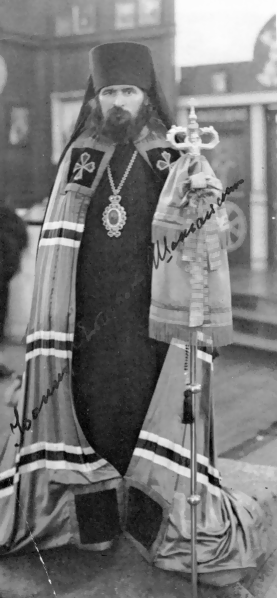
St. John of San Francisco and Shanghai
“Vladyka visited prisons and celebrated the Divine Liturgy for the convicts. On one occasion in Shanghai, Vladyka John was asked to give communion to a dying man in a Russian hospital. This time he took another priest with him. On his arrival he spotted a gregarious young man in his twenties, playing a harmonica. This lad was to be discharged the next day. Vladyka John called to him and said: “I want to give you communion right now.” The young man immediately confessed his sins and received communion. The astonished priest asked Vladyka why he did not go to the one dying, but tarried instead with an obviously healthy young man. Vladyka answered: “He will die tonight, and the other, who is seriously ill, will live many years.” It happened just as he foretold.
Vladyka loved to visit the sick and did it every single day, hearing confessions and giving Holy Communion. If the condition of a patient should become critical, Vladyka would go to him at any hour of the day or night to pray at his bedside. Here is one undoubted miracle among the many worked by Vladyka’s prayers; it was recorded and placed in the archives of the County Hospital in Shanghai.
L. D. Sadkovskaya was very much taken by the sport of horse racing. Once she was thrown off her horse; she hit her head on a rock and lost consciousness. She was brought to the hospital unconscious. A concilium of doctors agreed that her condition was hopeless and it was not likely that she would live until morning. The pulse was almost gone; the skull was fractured in places so that small pieces of the skull were pressing on the brain. In such a condition she would die on the operating table. Even if her heart would tolerate surgery and the result were successful, she would still remain deaf, dumb, and blind.
Her sister, after hearing all this, rushed to Bishop John in despair and begged him to save her sister. Vladyka agreed. He came to the hospital and asked everyone to leave the room and prayed there for about two hours. Then he called the chief doctor and asked him to examine her again. How surprised the doctor was to discover that her pulse was normal! He agreed to perform the operation immediately, but only in the presence of Bishop John. The operation was successful, and the doctors were amazed when, after the operation, the patient regained consciousness and asked to drink. Soon she was released from the hospital and lived for many years a normal life.” (Source)
He reposed in 1966.
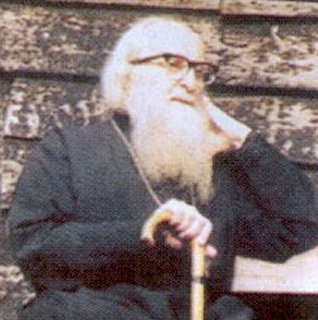
St. Sophrony of Essex
“In his letters, he says that at this time he felt that while he was walking on the earth and speaking to people, he did not feel the earth beneath his feet but an endlessly deep, black chasm. He was faced continually with the burning question which had haunted him since his early youth: ‘Am I eternal along with everyone else, or are we all destined for the black night of non-being?’ He was granted the grace of perceiving the dark veil of death and despair which envelop mankind and all life on earth.
After the Revolution, Sergei [his given name] fled abroad. He passed through Italy and Berlin in Germany, and finally settled in Paris at the end of 1922. In the years of his sojourn in Paris, he exhibited works of art in 1923 at the Salon d’Automne and in 1924 at the Salon des Tuilleries.
It was in Paris that Sergei returned to the Church. His conversion occurred when he came to know the true content of the revelation given by God to Moses on Mount Sinai, ‘I AM THAT I AM.’ By God’s grace he understood that the Absolute Being that he sought is none other than the personal God, Christ Himself. In 1924, on Holy Saturday, he experienced the Uncreated Light in such a way that he felt his personal resurrection and along with it the resurrection of the whole world. Saint Sophrony described this event in the third person in a letter:
“I know a man in Paris who from Holy Saturday until the third day of Easter, throughout three days, was in a state of theosis, something he could only express, within our earthly reference, by saying that he ‘beheld the dawn of the day without eventide’. ‘The dawn’ because the light was unusually delicate, fine, ‘tender’, in some ways sky blue in colour. ‘The day without eventide’ is eternity.” (Source)
He reposed in 1993 at the age of 97. I am blessed to know people who knew him.
Fr. Seraphim Rose
Likely the largest figure for Western, and specifically American converts to Orthodoxy, Fr. Seraphim Rose (originally Eugene) was born into a middle-class Protestant American background, living through and commenting on the the cultural and spiritual trends of the 60’s, 70’s, and early 80’s before his repose. Though a beloved Western figure in recent Orthodoxy, his writings had a global impact, especially behind the Iron Curtain during the U.S.S.R.
“Eugene studied in Pomona College, CA, and at the University of California in Berkeley. He was a man of wide culture, very gifted in languages, conversant in French and German. Besides, he learned Chinese and Japanese. Later on, he easily picked up Russian and Church Slavonic. He also studied the sciences, excelling in natural sciences. He was recognized by his professors as an exceptionally brilliant student.
He loved music (especially Bach), opera, literature, poetry. In English literature, he liked Dickens. He loved nature and animals. He was athletically built, and enjoyed sports in college. He was a practical man who could fix automobiles, make repairs and build a house.
But soon Eugene became disillusioned with the emptiness of modern life, its flat materialism, and with the only Christianity he knew: Protestant and Catholic, which he felt, had lost its spirituality. He also saw that science and technology, wrongly used, were slowly destroying the natural beautiful fabric of life. Looking for truth in the East, he studied Chinese culture and religion, Taoism, Buddhism, Zen and the hedonistic teachings of Alan Watts (a former Episcopalian priest, who had rejected his faith in favor of Zen Buddhism).
After a while, he also became disillusioned with the Eastern religions, finding them shallow. He came close to atheism, sensuality, and actual rebellion against God. He also came close to total skepticism, this terrible state of the human mind doubting all, drawing nearer and nearer to total madness and self-destruction. This state is well described in the classical book of Pavel Florenskii, The Pillar and Foundation of Truth.
But a miracle occurred. Eugene came to the night service at the Russian Orthodox Cathedral in San Francisco. It was Easter, Russian Easter, so notoriously exuberant and full of joy. Here he experienced something of the original spirit of Christianity from the time of the Apostles. He was overwhelmed by the beauty of the service, by all he saw and heard. He said: “Now I am at home.” He realized that he had found what he had been seeking all along. He experienced something neither intellectual nor aesthetic, but existential. And inside of him, there was burning, not a temporary exaltation, but a deep spiritual passion, a permanent determination to preserve no matter what, that was to last for his whole life. From then on, slowly, he became more and more engulfed in Orthodox Christianity. He changed gradually his mode of life, from worldly to ascetic.” (Source)
He reposed in 1982.
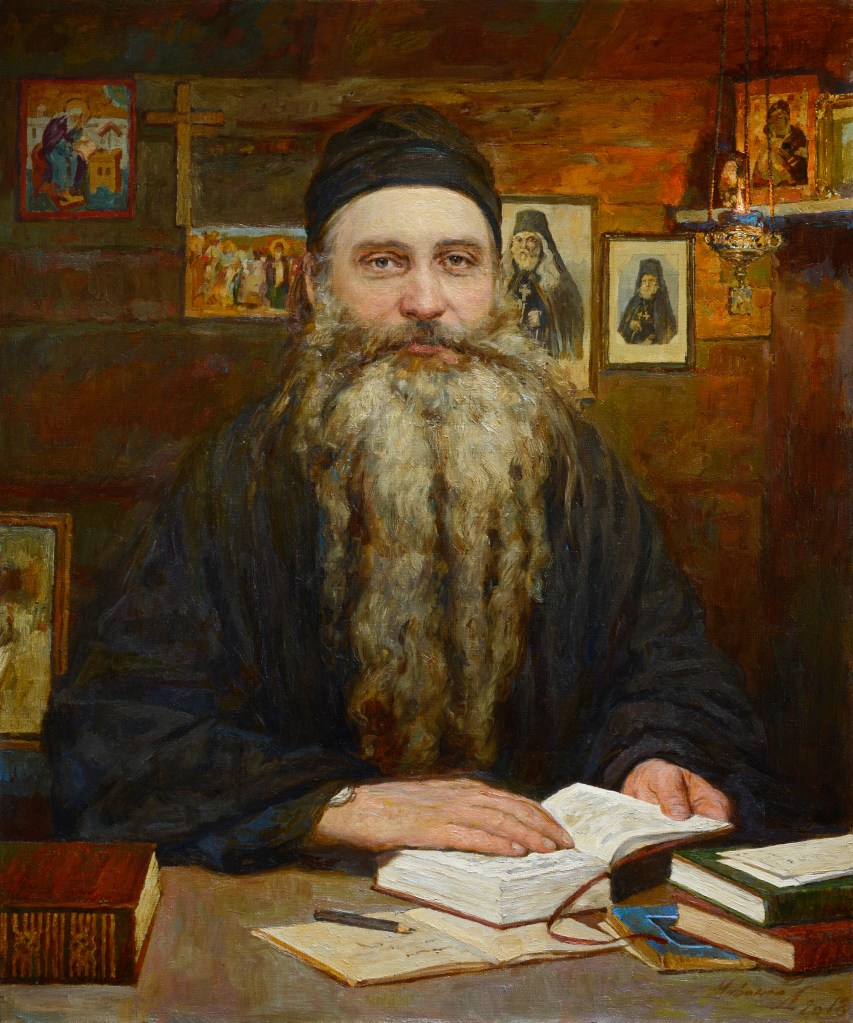
St. Gabriel of Georgia
An excerpt from his life for brevity:
“On May 1, 1965, during a demonstration, Hieromonk Gabriel burned a 12-meter portrait of Lenin which hung on the building which housed the Supreme Council of the Georgian SSR, and he began to preach about Christ to the people who were gathered there. He was severely beaten for this and put into a solitary confinement cell at the Georgian KGB. At the interrogation Fr. Gabriel said that he did it because “it is forbidden to treat a man like God. The Crucifixion of Christ ought to hang where the portrait of Lenin was. And you need to write, “Glory to the Lord Jesus Christ.” In August 1965 Fr. Gabriel was put into a psychiatric hospital for an examination. There he was diagnosed as insane: “A psychopathic individual who believes in God and angels.” (Source)

The Removal of Tradition and Beauty
Roman Catholics claim to have outstanding beauty which serves as a witness to the truth of their beliefs, but there are several things to unpack here. Firstly, are there absolutely beautiful Roman Catholic buildings? Of course, I have seen many of them myself and they absolutely have something of divinity in them. However with this being said, there is a progressive decline in Roman Catholic church architecture that from the Orthodox point of view, is in conjunction with the theological decline we see in Rome. Notre Dame was one of the primary symbols of French Catholicism, and any Christian or traditionalist would have justly wept at the fire that it was largely damaged by just a few years ago. However when it was reopened, the new altar was immediately noticeable. Look it up, seriously. I believe that the image speaks for itself, and presents a view of the current state of art within Catholicism, as do many other traditional Catholics. Also something to note that I often will raise in such discussions, is that the fact that some Catholics have to call themselves “traditional Catholics” to distinguish themselves from the majority, is in fact evidence as to the state of things. This is most clearly the case where Catholics will tell someone that they must submit to Rome, and in the very same breath decry all the modernism that is within their church. Yet another example is the modern redo of St. Hedwig’s Cathedral in Berlin. Below is the interior in 1886, and then today.
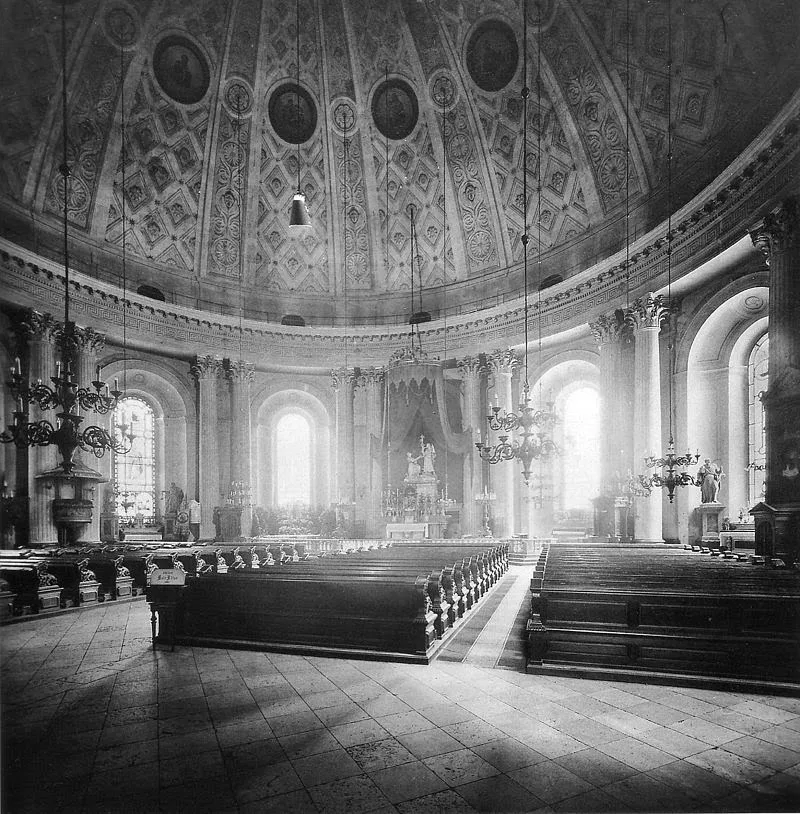

The standard Catholic Parish is not a gothic cathedral in France, or even the old village church that many Italians used to attend. It looks like a slightly better version of a standard protestant church.

The TLM
I have seen how Catholics often have a romanticized idea of what they are engaging with, and this is an extension of the TLM vs Novus Ordo debate. Many people such as Hickman advocate that if only parishioners stand up for what they want to see and voice their concerns, a more reverent Novus Ordo can likely come about in their community. Sure, but it is still the Novus Ordo, which so many Catholics rightfully have an issue with. One cannot go out and start building a life on the TLM without being directly opposed to the church hierarchy…at the very top.
“This ‘back-stepping’ makes us a sect; it makes you ‘closed’ and cuts off your horizons. Those people call themselves guardians of traditions, but of dead traditions.”
“The danger today is indietrismo, the reaction against the modern. It is a nostalgic disease. This is why I decided that now the permission to celebrate according to the Roman Missal of 1962 is mandatory for all newly consecrated priests”
It can be seen also how this was not in line with prior papal directives.
“Through the motu proprio Traditionis Custodes, Pope Francis placed sweeping restrictions on the celebration of Mass using the 1962 Roman Missal, known variously as the extraordinary form of the Roman rite, the Tridentine Mass, and the Traditional Latin Mass. Francis’ predecessor Pope Benedict XVI had issued a 2007 apostolic letter called Summorum Pontificum, which acknowledged the right of all priests to say Mass using the Roman Missal of 1962.”
I could go on for a while about the Novus Ordo, but I think that the quote below highlighting the bishop’ reactions to the Novus Ordo is enough.
“The bishops’ reaction was hardly enthusiastic. Only 71 synod fathers gave unqualified approval, while 62 wanted changes, 43 rejected it outright and four abstained. Cardinal John Heenan of Westminster was politely scathing, telling the synod that few of the consultors could ever have been parish priests, and that the Missa Normativa would reduce parish congregations to “mostly women and children.” Antonelli’s judgment was pithy: “The synod of bishops was not a success for the Consilium.” – “The Strange Birth of the Novus Ordo” from The Catholic Herald
Conclusion
“Repent, for the kingdom of heaven is at hand”
Matthew 3:2
This response was by no means all inclusive of what I want to say, or could say, but I feel that it serves as an appropriate summary of the major issues of Catholicism I am most familar with in response to the open letter of A.M. Hickman, while also providing an occasional Orthodox contrast. I wrote this in a spirit not of debate, but out of a spirit of wanting to share what I and increasingly so many others in the West, so strongly believe. I find incredibly deep aesthetic value in Roman Catholicism from the sense of traditionalism, and I recognize just how important it is as an institution to mainting society. There is a tremendous amount of work that can be done between Catholics and Orthodox on non-theological issues, as both of our communities face increasing pressure from the secular world. I do not say that we should work together for the sake of a traditionalist and broadly Christian future, but it is imperative.
At the end of the day, I choose Orthodoxy because it not only allows me to sleep at night with a good conscience, but allows me to be completely confident in my assent to its teachings, in totality. I do not have to deny a single thing that the Orthodox teach churches. I do not have to call myself a “traditional Orthodox.” I do not have to find a specific parish to experience the right liturgy. I do not have to be in opposition to the pope’s anti-traditionalism. I never have to worry about any of these concerns! I choose spirituality over legalism, the soul over the mind. Would I say that the Orthodox Church is a perfect institution? No, we are still on earth in a fallen world. Would I say that what the Orthodox Church teaches is perfect and that it is the Only, Holy, Catholic, and Apostolic Church that our Lord and Savior Jesus Christ established? Absolutely, yes, without a single doubt or concern ever entering my mind. May all glory be to Him who made me, for all else is vanity.
“I am an Orthodox Christian and I will not betray my Faith.”
– St. Peter The Aleut
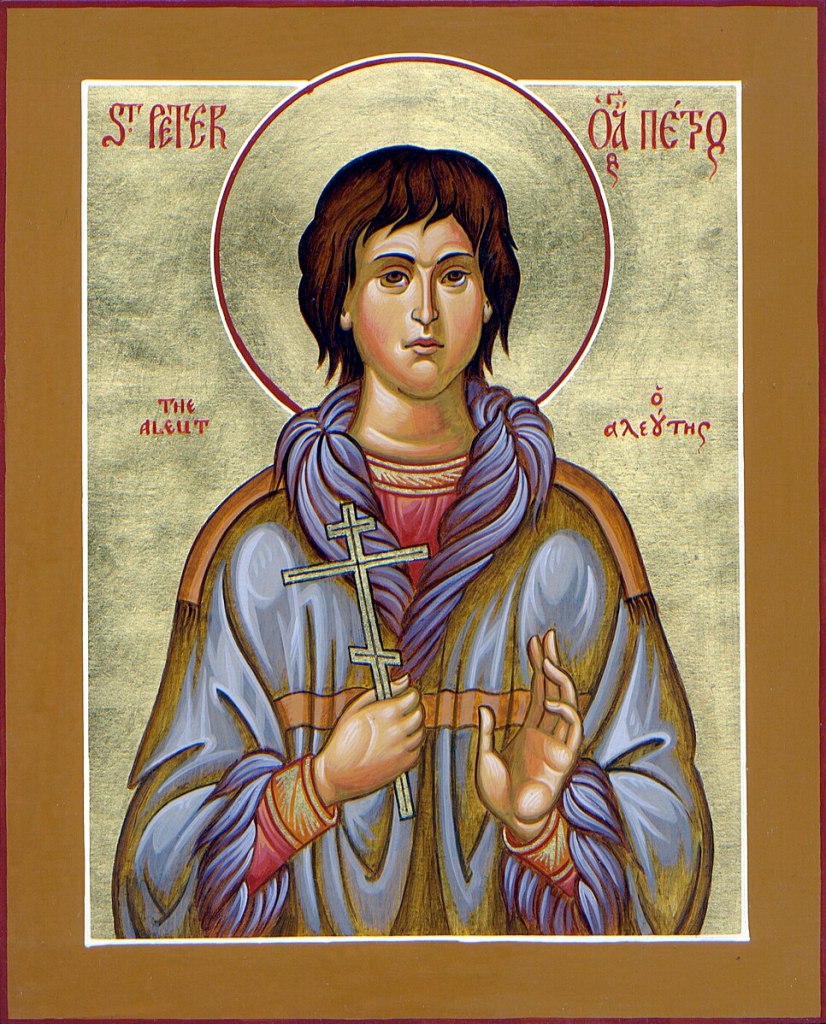
Paul Drozdowski, CC BY 2.0 via Wikimedia Commons
 Collin Cooper